
Sourced from Croquet New Zealand :
Golf Croquet
Golf Croquet is a game in itself, completely separate from Association Croquet. Although it has a long history, It has experienced a recent resurgence of interest at all levels.
There are many Golf Croquet tournaments including regular World Championships, so it is not just a beginner’s game.
It has a much simpler set of rules and therefore can be learned more quickly than Association Croquet. Games are generally more interactive and take less time to complete. This makes it attractive to those who do not have the time to play Association Croquet, and beginners can use it to acquire some useful croquet skills.
Games of Golf Croquet are started from within a yard of the 4th corner. Note: There are no yardlines in Golf Croquet.
The basics of the game
As in Association Croquet the blue and black balls play against red and yellow (if you are using secondary colours then it is green and brown, against pink and white). Games can either be singles or doubles. If it is doubles then each of the two partners has one ball only.
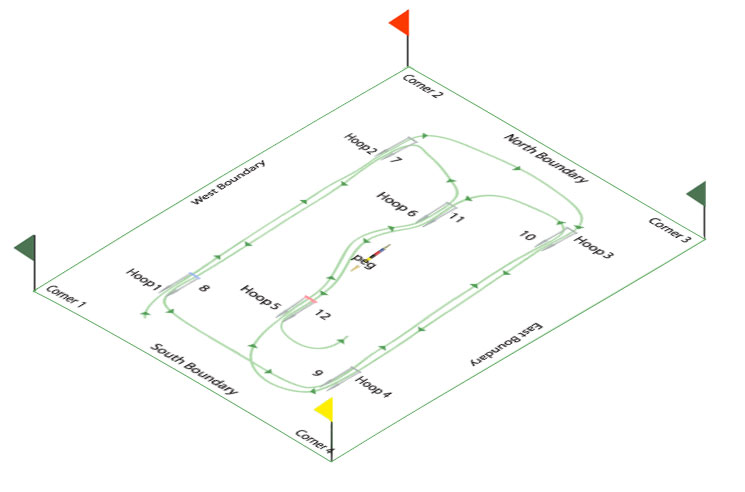
Starting from corner 4 everyone is for the same hoop (starting with hoop 1), and a point is scored for the side whose ball first runs the hoop in order. To run a hoop in order means to run it in the correct direction. The normal hoop order and direction applies. The order and direction that hoops are played are shown in the court diagram above.
Each person has only the one stroke in each turn. The balls are played in colour sequence – blue, red, black, and then yellow. This sequence is shown by the colours on the peg. If two games are being played on the same lawn then different coloured balls are used for the second game – in sequence green, pink, brown and white.
Before the game there is a toss and the winner then plays blue – the first ball towards hoop one, followed by the other player(s) in the game. By the second turn it is usual to find players trying to get right in front or even through the first hoop. As soon as one player makes that hoop, then all players contest the next in order.
If a player is unable to make a hoop, and sees that an opponent might do so, there is a temptation to sneak towards the next hoop in order. There are penalties for doing so.
It is not necessary for a ball to go through a hoop in one shot. Sticking in the jaws is O.K. until the next turn for that ball, BUT an opponent is allowed to knock the ball out. If the ball is knocked through the hoop by an opponent, the opponent gives the first player the point.
Games can consist of the best of 7, 13 or (even) 19 hoops, so that the first player to make 4, 7 or 10 hoops is the winner. In the 19 point game, the first 12 hoops are run in order and the next hoops are 3,4,1,2,11 and 12. If players are even up until the last hoop, then the last hoop played in the 13 and 19 hoop games is hoop 3.
Guide to Golf Croquet Tactics
This is a very simple introduction to the tactics of Golf Croquet. There are skills in playing this version of the game and of particular importance is the ability to hit straight either in order to make hoops or knock other balls away.
The objective is to get through a hoop before the opponent does and two basic strategies used to achieve this are to:
- Knock the opponent balls away; and
- Put your ball between the opponent’s ball and the hoop or even to protect your other ball if it is in a good position.
A useful shot when blocked is the jump shot, where, by hitting down on a ball, a player makes it jump forwards – usually over an opponent’s ball, or to make a difficult hoop (i.e. from an acute side angle).
Note: it is now possible under the laws for a player to use a jump shot to go through a hoop (see law 6(e) which has removed the previous restriction on this ploy.
When playing, it is important to remember the sequence of balls, and to plan how to protect your own balls while frustrating your opponent. For example, you might wish to send a ball behind the hoop to be in a position to knock the opponent’s next ball out of or away from the hoop.
Once the basics have been mastered, players must become familiar with the rules – fortunately there are only 16 of these. The rules concerning interference and faults require study and those concerning behaviour and the respect for referees are different to what an Association Croquet player might expect. If you are to enter a tournament, you must have a handicap, and Law 16 sets out how this can be done. Finally the rules about playing for the next hoop must be understood.
Association Croquet
Outline of Association Croquet
Modern croquet is played as a singles or doubles game in which two sides compete against each other by hitting balls through a sequence of 12 hoops. In singles one player takes two balls and in any turn decides to play whichever ball is better placed. In doubles, partners take one ball each but they must also decide which is the best ball to play during a turn. By playing a sequence of strokes, players may keep a turn going and complete several or all hoops in a single turn. The game is won when two balls of one side complete all the hoops and “peg out”, or if they are ahead when time is called. The art of the game is to master the physical side of using a mallet to hit balls very accurately, and to be able to plan a winning strategy.
Scoring by making hoops
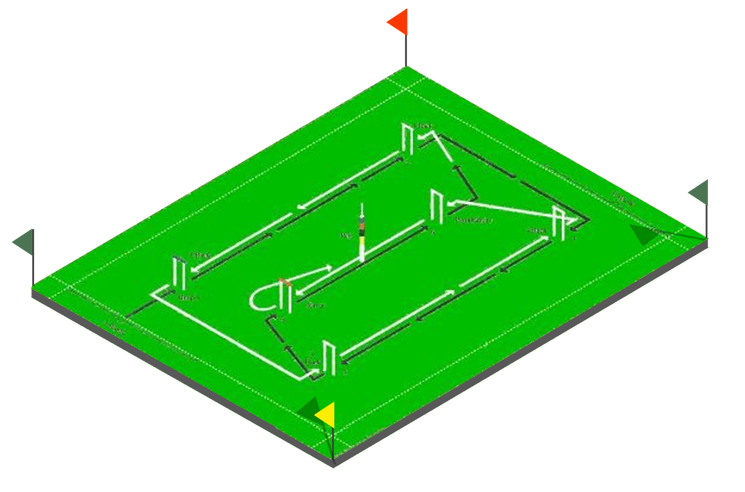
The balls are hit through six hoops in one direction and then through the same six hoops but in a reverse direction. The final shot is to hit the peg in the middle of the lawn. The side which “pegs out” both balls wins the game. As each ball may pass through 12 hoops and then hit the peg, it can earn 13 points. With two balls to a side, a game can thus be won by scoring 26 points. Most matches are played to a time limit, and if this is reached, the winning side is the one which has scored the most points.
Sequences of strokes
Players make a sequence of shots by hitting their ball onto another (called a roquet). The player then places their ball against the hit ball and plays a two-ball shot(called a croquet shot) in order to get near another ball or a hoop. They then play a further shot (a continuation stroke) to try and hit yet another ball or pass through a hoop. Thus the sequence of shots is roquet, croquet and continuation.
Making breaks
In any one turn, a player may use any of the other three balls on the lawn once in making the sequence of shots before making a hoop. When a hoop is made, the three other balls may be used again. By using up to three of the shot sequences, a player may move from one hoop to the next and thus make a whole series of hoops in the one turn – called a break. Coloured clips placed on hoops are used to mark a player’s progress.
Use of strategy
The game involves considerable strategy in placing balls in order to make breaks, and skilled players can finish a game in a few turns. Many players do not achieve this level of skill, but can still play successfully against more skilled players in handicap games where they can have extra turns (called bisques) which reflect the differences in ability.The game thus involves exercise, physical skill and the ability to develop a strategy for making breaks and winning games. This is why it has be likened to a combination of chess and billiards played on lawns. It suits both young and old (the age range of players ranges from 7 years to over 90). Some enjoy it for the social elements of club play, and others play it competitively. It is truly a game for all reasons.
Laws of croquet
For more information see the laws and regulations of croquet, All files are included in a one time downloadable .zip file.
 Petone Central Croquet Club
Very well presented. The best explanation I’ve yet seen of the complexities of AC.
LikeLiked by 1 person